Shape Memory Polyurethanes (SMPs) for Intracranial Aneurysm Treatment
Intracranial aneurysms (ICAs) are focal dilations of a blood vessel within the brain, present in approximately 1.3 million Americans. ICAs, if left untreated, can progressively grow as the vessel wall further weakens, potentially leading to rupture. ICA rupture can induce subarachnoid hemorrhage, a dangerous condition with a case fatality rate surpassing 50%. Endovascular coil embolization is the current gold standard for ICAs. However, aneurysm recurrence has been witnessed in up to 44% of cases within 5 years of initial treatment, requiring retreatment in most cases. Furthermore, severe complications including coil migration and coil protrusion have been observed with coil-based methods. Irregular or complex aneurysms are both the most prone to rupture and the most difficult to treat with current endovascular techniques. This limitation of current technologies highlights the need for further innovation in this space. Therefore, we aim to develop a patient-specific intrasaccular device that targets irregular ICAs which currently lack sufficient clinical options. Our primary objectives are to (1) develop a computational pipeline to elucidate aneurysm hemodynamics and guide device design, (2) design embolic devices based on computational and experimental data, and (3) evaluate our devices using in-vitro aneurysm phantoms within a PIV flow loop and eventual in-vivo trials with an animal model.
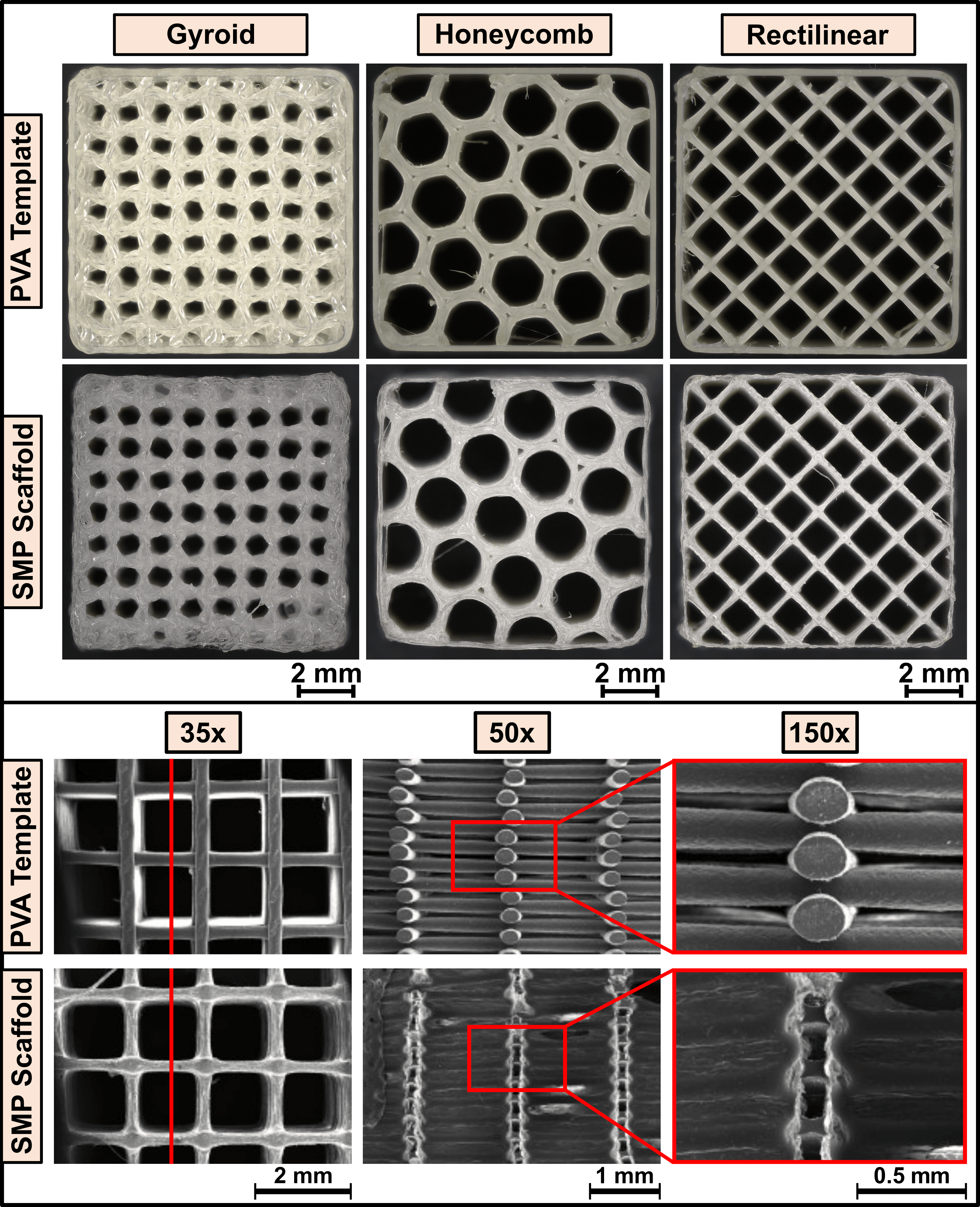
Our endovascular, patient-specific devices are composed of a shape memory polyurethane (SMP) that is synthesized in-house. Our fabrication process involves a sacrificial templating method in which water-soluble, polyvinyl alcohol (PVA) templates are 3D printed prior to being coated with our SMP prepolymer. The coated templates are subsequently cured, and the sacrificial PVA templates dissolved, leaving high fidelity SMP scaffolds. Once the scaffolds have been generated, material characterization experiments are conducted elucidating mechanical, thermal, and chemical properties. Further understanding of these material characteristics informs device design and guides material optimizations.
Computational Fluid Dynamics for Intracranial Aneurysm Treatment
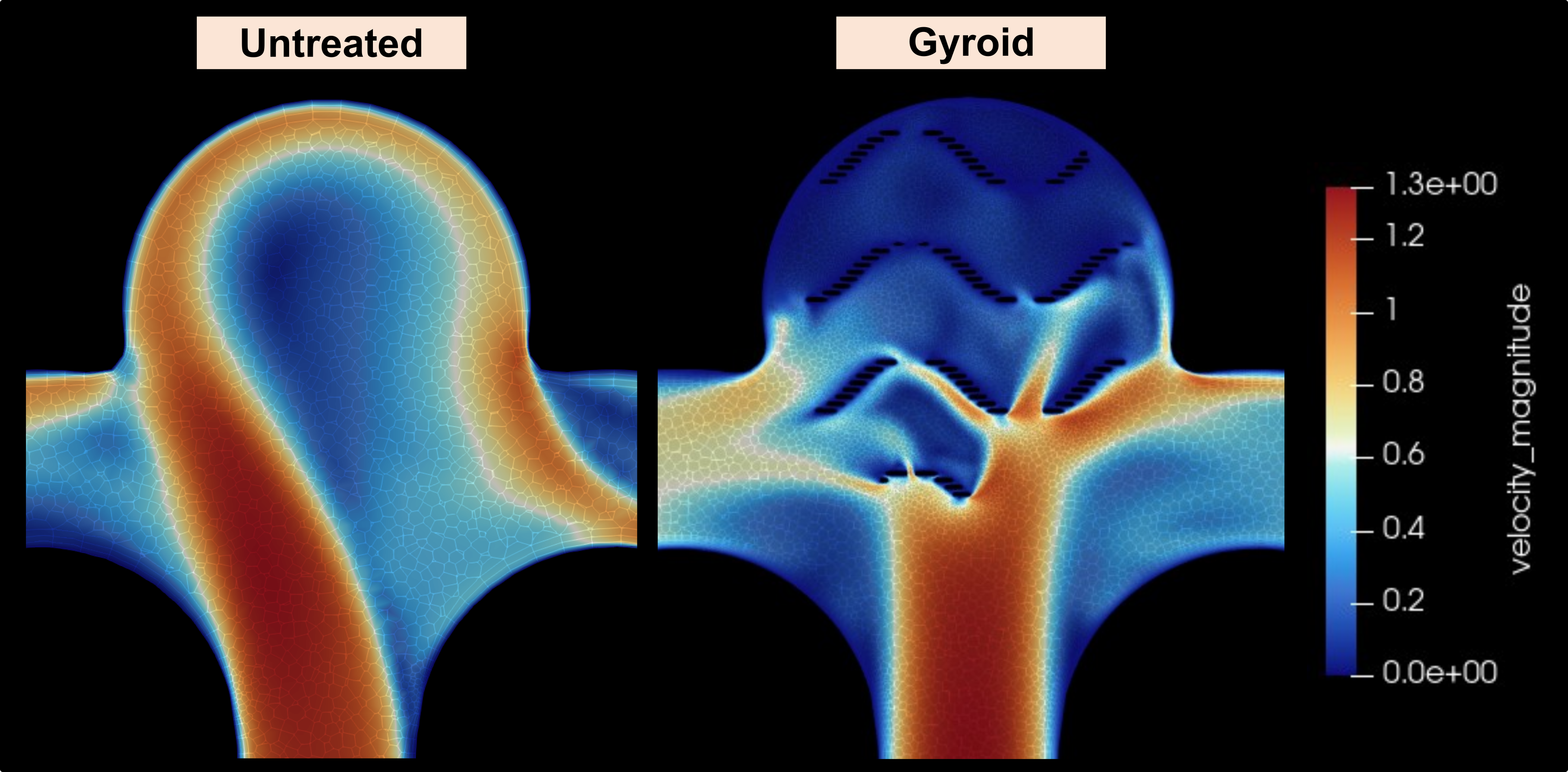
A computational fluid dynamics (CFD) approach is employed to evaluate, in-silico, aneurysms with idealized and patient-specific geometry for untreated and treated conditions. These simulations inform device design and deployment strategies. Primarily, these simulations are focused on aneurysm hemodynamics, however, heat transfer during device deployment has also been considered previously. CFD schemes include both steady-state and pulsatile approaches utilizing transition and turbulent fluid models. Currently, we are developing a computational pipeline to efficiently evaluate various scaffold designs for their respective treatment efficacy. In combination with our experimental methods for validation, our computational pipeline will enable the rapid optimization and latter production of high efficacy patient-specific endovascular devices.
Opportunities for Students and Collaborators
We welcome inquiries from prospective students, researchers, and collaborators. If you're interested in joining the Biomechanics and Biomaterials Design Lab (BBDL) please fill out this form: Interest Form. If you would like to explore a research collaboration, please contact Dr. Chung-Hao Lee at chunghao.lee@ucr.edu
We look forward to hearing from you!
We Would Like to Thank the Following Funding That Supports Our Research