005 Sample Final A, Question 18

From Grad Wiki
Revision as of 20:16, 30 April 2015 by Matt Lee (talk | contribs) (Created page with "''' Question ''' Graph the following function, <center><math>f(x) = \left(\frac{1}{3}\right)^{x+1} + 1</math></center> <br> Make sure to label any asymptotes, and at least two...")
(diff) ← Older revision | Latest revision (diff) | Newer revision → (diff)
Jump to navigation Jump to search

Question Graph the following function,
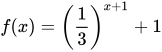
Failed to parse (MathML with SVG or PNG fallback (recommended for modern browsers and accessibility tools): Invalid response ("Math extension cannot connect to Restbase.") from server "https://wikimedia.org/api/rest_v1/":): {\displaystyle f(x) = \left(\frac{1}{3}\right)^{x+1} + 1}


Make sure to label any asymptotes, and at least two points on the graph.


Final Answers
a) False. Nothing in the definition of a geometric sequence requires the common ratio to be always positive. For example, Failed to parse (MathML with SVG or PNG fallback (recommended for modern browsers and accessibility tools): Invalid response ("Math extension cannot connect to Restbase.") from server "https://wikimedia.org/api/rest_v1/":): {\displaystyle a_n = (-a)^n}
b) False. Linear systems only have a solution if the lines intersect. So y = x and y = x + 1 will never intersect because they are parallel.
c) False. Failed to parse (MathML with SVG or PNG fallback (recommended for modern browsers and accessibility tools): Invalid response ("Math extension cannot connect to Restbase.") from server "https://wikimedia.org/api/rest_v1/":): {\displaystyle y = x^2} does not have an inverse.
d) True. Failed to parse (MathML with SVG or PNG fallback (recommended for modern browsers and accessibility tools): Invalid response ("Math extension cannot connect to Restbase.") from server "https://wikimedia.org/api/rest_v1/":): {\displaystyle cos^2(x) - cos(x) = 0} has multiple solutions.
e) True.
f) False.
