009C Sample Final 3, Problem 7 Detailed Solution
A curve is given in polar coordinates by
- Failed to parse (MathML with SVG or PNG fallback (recommended for modern browsers and accessibility tools): Invalid response ("Math extension cannot connect to Restbase.") from server "https://wikimedia.org/api/rest_v1/":): {\displaystyle r=1+\cos^2(2\theta).}
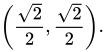
(a) Show that the point with Cartesian coordinates Failed to parse (MathML with SVG or PNG fallback (recommended for modern browsers and accessibility tools): Invalid response ("Math extension cannot connect to Restbase.") from server "https://wikimedia.org/api/rest_v1/":): {\displaystyle (x,y)=\bigg(\frac{\sqrt{2}}{2},\frac{\sqrt{2}}{2}\bigg)} belongs to the curve.
(b) Sketch the curve.
(c) In Cartesian coordinates, find the equation of the tangent line at
| Background Information: |
|---|
| 1. What two pieces of information do you need to write the equation of a line? |
|
You need the slope of the line and a point on the line. |
| 2. How do you calculate Failed to parse (MathML with SVG or PNG fallback (recommended for modern browsers and accessibility tools): Invalid response ("Math extension cannot connect to Restbase.") from server "https://wikimedia.org/api/rest_v1/":): {\displaystyle y'} for a polar curve Failed to parse (MathML with SVG or PNG fallback (recommended for modern browsers and accessibility tools): Invalid response ("Math extension cannot connect to Restbase.") from server "https://wikimedia.org/api/rest_v1/":): {\displaystyle r=f(\theta)?} |
|
Since Failed to parse (MathML with SVG or PNG fallback (recommended for modern browsers and accessibility tools): Invalid response ("Math extension cannot connect to Restbase.") from server "https://wikimedia.org/api/rest_v1/":): {\displaystyle x=r\cos(\theta)} and Failed to parse (MathML with SVG or PNG fallback (recommended for modern browsers and accessibility tools): Invalid response ("Math extension cannot connect to Restbase.") from server "https://wikimedia.org/api/rest_v1/":): {\displaystyle y=r\sin(\theta),} we have |
|
Failed to parse (MathML with SVG or PNG fallback (recommended for modern browsers and accessibility tools): Invalid response ("Math extension cannot connect to Restbase.") from server "https://wikimedia.org/api/rest_v1/":): {\displaystyle y'=\frac{dy}{dx}=\frac{(\frac{dr}{d\theta})\sin\theta+r\cos\theta}{(\frac{dr}{d\theta})\cos\theta-r\sin\theta}.} |
Solution:
(a)
| Step 1: |
|---|
| First, we need to convert this Cartesian point into polar. |
| We have |
| Failed to parse (MathML with SVG or PNG fallback (recommended for modern browsers and accessibility tools): Invalid response ("Math extension cannot connect to Restbase.") from server "https://wikimedia.org/api/rest_v1/":): {\displaystyle \begin{array}{rcl} \displaystyle{r} & = & \displaystyle{\sqrt{x^2+y^2}}\\ &&\\ & = & \displaystyle{\sqrt{\frac{2}{4}+\frac{2}{4}}}\\ &&\\ & = & \displaystyle{\sqrt{1}}\\ &&\\ & = & \displaystyle{1.} \end{array}} |
| Also, we have |
| Failed to parse (MathML with SVG or PNG fallback (recommended for modern browsers and accessibility tools): Invalid response ("Math extension cannot connect to Restbase.") from server "https://wikimedia.org/api/rest_v1/":): {\displaystyle \begin{array}{rcl} \displaystyle{\tan \theta } & = & \displaystyle{\frac{y}{x}}\\ &&\\ & = & \displaystyle{1.} \end{array}} |
| So, Failed to parse (MathML with SVG or PNG fallback (recommended for modern browsers and accessibility tools): Invalid response ("Math extension cannot connect to Restbase.") from server "https://wikimedia.org/api/rest_v1/":): {\displaystyle \theta=\frac{\pi}{4}.} |
| Now, this point in polar is Failed to parse (MathML with SVG or PNG fallback (recommended for modern browsers and accessibility tools): Invalid response ("Math extension cannot connect to Restbase.") from server "https://wikimedia.org/api/rest_v1/":): {\displaystyle \bigg(1,\frac{\pi}{4}\bigg).} |
| Step 2: |
|---|
| Now, we plug in Failed to parse (MathML with SVG or PNG fallback (recommended for modern browsers and accessibility tools): Invalid response ("Math extension cannot connect to Restbase.") from server "https://wikimedia.org/api/rest_v1/":): {\displaystyle \theta=\frac{\pi}{4}} into our polar equation. |
| We get |
| Failed to parse (MathML with SVG or PNG fallback (recommended for modern browsers and accessibility tools): Invalid response ("Math extension cannot connect to Restbase.") from server "https://wikimedia.org/api/rest_v1/":): {\displaystyle \begin{array}{rcl} \displaystyle{r} & = & \displaystyle{1+\cos^2\bigg(\frac{2\pi}{4}\bigg)}\\ &&\\ & = & \displaystyle{1+(0)^2}\\ &&\\ & = & \displaystyle{1.} \end{array}} |
| So, the point Failed to parse (MathML with SVG or PNG fallback (recommended for modern browsers and accessibility tools): Invalid response ("Math extension cannot connect to Restbase.") from server "https://wikimedia.org/api/rest_v1/":): {\displaystyle (x,y)} belongs to the curve. |
| (b) |
|---|
(c)
| Step 1: |
|---|
| Since Failed to parse (MathML with SVG or PNG fallback (recommended for modern browsers and accessibility tools): Invalid response ("Math extension cannot connect to Restbase.") from server "https://wikimedia.org/api/rest_v1/":): {\displaystyle r=1+\cos^2(2\theta),} |
|
Failed to parse (MathML with SVG or PNG fallback (recommended for modern browsers and accessibility tools): Invalid response ("Math extension cannot connect to Restbase.") from server "https://wikimedia.org/api/rest_v1/":): {\displaystyle \frac{dr}{d\theta}=-4\cos(2\theta)\sin(2\theta).} |
| Since |
|
Failed to parse (MathML with SVG or PNG fallback (recommended for modern browsers and accessibility tools): Invalid response ("Math extension cannot connect to Restbase.") from server "https://wikimedia.org/api/rest_v1/":): {\displaystyle y'=\frac{dy}{dx}=\frac{(\frac{dr}{d\theta})\sin\theta+r\cos\theta}{(\frac{dr}{d\theta})\cos\theta-r\sin\theta},} |
| we have |
|
Failed to parse (MathML with SVG or PNG fallback (recommended for modern browsers and accessibility tools): Invalid response ("Math extension cannot connect to Restbase.") from server "https://wikimedia.org/api/rest_v1/":): {\displaystyle \begin{array}{rcl} \displaystyle{\frac{dy}{dx}} & = & \displaystyle{\frac{-4\cos(2\theta)\sin(2\theta)\sin\theta+(1+\cos^2(2\theta))\cos\theta}{-4\cos(2\theta)\sin(2\theta)\cos\theta-(1+\cos^2(2\theta))\sin\theta}.}\\ \end{array}} |
| Step 2: |
|---|
| Now, recall from part (a) that the given point in polar coordinates is Failed to parse (MathML with SVG or PNG fallback (recommended for modern browsers and accessibility tools): Invalid response ("Math extension cannot connect to Restbase.") from server "https://wikimedia.org/api/rest_v1/":): {\displaystyle \bigg(1,\frac{\pi}{4}\bigg).} |
| Therefore, the slope of the tangent line at this point is |
| Failed to parse (MathML with SVG or PNG fallback (recommended for modern browsers and accessibility tools): Invalid response ("Math extension cannot connect to Restbase.") from server "https://wikimedia.org/api/rest_v1/":): {\displaystyle \begin{array}{rcl} \displaystyle{m} & = & \displaystyle{\frac{-4\cos(\frac{\pi}{2})\sin(\frac{\pi}{2})\sin(\frac{\pi}{4})+(1+\cos^2(\frac{\pi}{2}))\cos(\frac{\pi}{4})}{-4\cos(\frac{\pi}{2})\sin(\frac{\pi}{2})\cos(\frac{\pi}{4})-(1+\cos^2(\frac{\pi}{2}))\sin(\frac{\pi}{4})}}\\ &&\\ & = & \displaystyle{\frac{0+(1)(\frac{\sqrt{2}}{2})}{0-(1)(\frac{\sqrt{2}}{2})}}\\ &&\\ & = & \displaystyle{-1.} \end{array}} |
| Therefore, the equation of the tangent line at the point Failed to parse (MathML with SVG or PNG fallback (recommended for modern browsers and accessibility tools): Invalid response ("Math extension cannot connect to Restbase.") from server "https://wikimedia.org/api/rest_v1/":): {\displaystyle (x,y)} is |


| Final Answer: |
|---|
| (a) See above. |
| (b) See above. |
| (c) Failed to parse (MathML with SVG or PNG fallback (recommended for modern browsers and accessibility tools): Invalid response ("Math extension cannot connect to Restbase.") from server "https://wikimedia.org/api/rest_v1/":): {\displaystyle y=-1\bigg(x-\frac{\sqrt{2}}{2}\bigg)+\frac{\sqrt{2}}{2}} |