Consider the series

(a) Test if the series converges absolutely. Give reasons for your answer.
(b) Test if the series converges conditionally. Give reasons for your answer.
| Background Information:
|
| 1. A series Failed to parse (Conversion error. Server ("https://wikimedia.org/api/rest_") reported: "Cannot get mml. Server problem."): {\displaystyle \sum a_{n}}
is absolutely convergent if
|
| the series Failed to parse (Conversion error. Server ("https://wikimedia.org/api/rest_") reported: "Cannot get mml. Server problem."): {\displaystyle \sum |a_{n}|}
converges.
|
| 2. A series Failed to parse (Conversion error. Server ("https://wikimedia.org/api/rest_") reported: "Cannot get mml. Server problem."): {\displaystyle \sum a_{n}}
is conditionally convergent if
|
| the series Failed to parse (Conversion error. Server ("https://wikimedia.org/api/rest_") reported: "Cannot get mml. Server problem."): {\displaystyle \sum |a_{n}|}
diverges and the series Failed to parse (Conversion error. Server ("https://wikimedia.org/api/rest_") reported: "Cannot get mml. Server problem."): {\displaystyle \sum a_{n}}
converges.
|
Solution:
(a)
| Step 1:
|
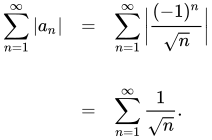
| First, we take the absolute value of the terms in the original series.
|
| Let Failed to parse (Conversion error. Server ("https://wikimedia.org/api/rest_") reported: "Cannot get mml. Server problem."): {\displaystyle a_{n}={\frac {(-1)^{n}}{\sqrt {n}}}.}
|
| Therefore,
|
| Failed to parse (Conversion error. Server ("https://wikimedia.org/api/rest_") reported: "Cannot get mml. Server problem."): {\displaystyle {\begin{array}{rcl}\displaystyle {\sum _{n=1}^{\infty }|a_{n}|}&=&\displaystyle {\sum _{n=1}^{\infty }{\bigg |}{\frac {(-1)^{n}}{\sqrt {n}}}{\bigg |}}\\&&\\&=&\displaystyle {\sum _{n=1}^{\infty }{\frac {1}{\sqrt {n}}}.}\end{array}}}
|
| Step 2:
|
This series is a -series with
|
| Therefore, it diverges.
|
| Hence, the series
|
| Failed to parse (Conversion error. Server ("https://wikimedia.org/api/rest_") reported: "Cannot get mml. Server problem."): {\displaystyle \sum _{n=1}^{\infty }{\frac {(-1)^{n}}{\sqrt {n}}}}
|
| is not absolutely convergent.
|
|
|
(b)
| Step 1:
|
| For
|
| Failed to parse (MathML with SVG or PNG fallback (recommended for modern browsers and accessibility tools): Invalid response ("Math extension cannot connect to Restbase.") from server "https://wikimedia.org/api/rest_v1/":): {\displaystyle \sum_{n=1}^\infty \frac{(-1)^n}{\sqrt{n}},}
|
| we notice that this series is alternating.
|
| Let Failed to parse (MathML with SVG or PNG fallback (recommended for modern browsers and accessibility tools): Invalid response ("Math extension cannot connect to Restbase.") from server "https://wikimedia.org/api/rest_v1/":): {\displaystyle b_n=\frac{1}{\sqrt{n}}.}
|
| First, we have
|
| Failed to parse (MathML with SVG or PNG fallback (recommended for modern browsers and accessibility tools): Invalid response ("Math extension cannot connect to Restbase.") from server "https://wikimedia.org/api/rest_v1/":): {\displaystyle \frac{1}{\sqrt{n}}\ge 0}
|
| for all Failed to parse (MathML with SVG or PNG fallback (recommended for modern browsers and accessibility tools): Invalid response ("Math extension cannot connect to Restbase.") from server "https://wikimedia.org/api/rest_v1/":): {\displaystyle n\ge 1.}
|
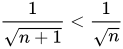
| The sequence Failed to parse (MathML with SVG or PNG fallback (recommended for modern browsers and accessibility tools): Invalid response ("Math extension cannot connect to Restbase.") from server "https://wikimedia.org/api/rest_v1/":): {\displaystyle \{b_n\}}
is decreasing since
|
| Failed to parse (MathML with SVG or PNG fallback (recommended for modern browsers and accessibility tools): Invalid response ("Math extension cannot connect to Restbase.") from server "https://wikimedia.org/api/rest_v1/":): {\displaystyle \frac{1}{\sqrt{n+1}}<\frac{1}{\sqrt{n}}}
|
| for all Failed to parse (MathML with SVG or PNG fallback (recommended for modern browsers and accessibility tools): Invalid response ("Math extension cannot connect to Restbase.") from server "https://wikimedia.org/api/rest_v1/":): {\displaystyle n\ge 1.}
|
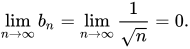
| Also,
|
| Failed to parse (MathML with SVG or PNG fallback (recommended for modern browsers and accessibility tools): Invalid response ("Math extension cannot connect to Restbase.") from server "https://wikimedia.org/api/rest_v1/":): {\displaystyle \lim_{n\rightarrow \infty}b_n=\lim_{n\rightarrow \infty}\frac{1}{\sqrt{n}}=0.}
|
| Therefore, the series Failed to parse (MathML with SVG or PNG fallback (recommended for modern browsers and accessibility tools): Invalid response ("Math extension cannot connect to Restbase.") from server "https://wikimedia.org/api/rest_v1/":): {\displaystyle \sum_{n=1}^\infty \frac{(-1)^n}{\sqrt{n}}}
converges
|
| by the Alternating Series Test.
|
| Step 2:
|
| Since the series Failed to parse (MathML with SVG or PNG fallback (recommended for modern browsers and accessibility tools): Invalid response ("Math extension cannot connect to Restbase.") from server "https://wikimedia.org/api/rest_v1/":): {\displaystyle \sum_{n=1}^\infty \frac{(-1)^n}{\sqrt{n}}}
is not absolutely convergent but convergent,
|
| this series is conditionally convergent.
|
| Final Answer:
|
| (a) not absolutely convergent (by the Failed to parse (MathML with SVG or PNG fallback (recommended for modern browsers and accessibility tools): Invalid response ("Math extension cannot connect to Restbase.") from server "https://wikimedia.org/api/rest_v1/":): {\displaystyle p}
-series test)
|
| (b) conditionally convergent (by the Alternating Series Test)
|
Return to Sample Exam