009B Sample Final 3, Problem 4 Detailed Solution
Revision as of 16:44, 2 December 2017 by Kayla Murray (talk | contribs) (Created page with "<span class="exam"> Find the volume of the solid obtained by rotating about the <math>x</math>-axis the region bounded by <math style="vertical-align: -4px">y=\sqr...")
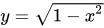
Find the volume of the solid obtained by rotating about the -axis the region bounded by and
| Background Information: |
|---|
| 1. You can find the intersection points of two functions, say |
|
by setting and solving for |
| 2. The volume of a solid obtained by rotating a region around the -axis using disk method is given by |
|
where is the radius of the disk. |
Solution:
| Step 1: |
|---|
| We start by finding the intersection points of the functions and |
| We need to solve |
| If we square both sides, we get |
| Failed to parse (MathML with SVG or PNG fallback (recommended for modern browsers and accessibility tools): Invalid response ("Math extension cannot connect to Restbase.") from server "https://wikimedia.org/api/rest_v1/":): {\displaystyle 0=1-x^2.} |
| The solutions to this equation are Failed to parse (MathML with SVG or PNG fallback (recommended for modern browsers and accessibility tools): Invalid response ("Math extension cannot connect to Restbase.") from server "https://wikimedia.org/api/rest_v1/":): {\displaystyle x=-1} and Failed to parse (MathML with SVG or PNG fallback (recommended for modern browsers and accessibility tools): Invalid response ("Math extension cannot connect to Restbase.") from server "https://wikimedia.org/api/rest_v1/":): {\displaystyle x=1.} |
| Hence, we are interested in the region between Failed to parse (MathML with SVG or PNG fallback (recommended for modern browsers and accessibility tools): Invalid response ("Math extension cannot connect to Restbase.") from server "https://wikimedia.org/api/rest_v1/":): {\displaystyle x=-1} and Failed to parse (MathML with SVG or PNG fallback (recommended for modern browsers and accessibility tools): Invalid response ("Math extension cannot connect to Restbase.") from server "https://wikimedia.org/api/rest_v1/":): {\displaystyle x=1.} |
| Step 2: |
|---|
| Using the disk method, the radius of each disk is given by |
| Failed to parse (MathML with SVG or PNG fallback (recommended for modern browsers and accessibility tools): Invalid response ("Math extension cannot connect to Restbase.") from server "https://wikimedia.org/api/rest_v1/":): {\displaystyle r=\sqrt{1-x^2}.} |
| Therefore, the volume of the solid is |
| Failed to parse (MathML with SVG or PNG fallback (recommended for modern browsers and accessibility tools): Invalid response ("Math extension cannot connect to Restbase.") from server "https://wikimedia.org/api/rest_v1/":): {\displaystyle \begin{array}{rcl} \displaystyle{V} & = & \displaystyle{\int_{-1}^1 \pi (\sqrt{1-x^2})^2~dx}\\ &&\\ & = & \displaystyle{\int_{-1}^1 \pi (1-x^2)~dx}\\ &&\\ & = & \displaystyle{\pi\bigg(x-\frac{x^3}{3}\bigg)\bigg|_{-1}^1}\\ &&\\ & = & \displaystyle{\pi\bigg(1-\frac{1}{3}\bigg)-\pi\bigg(-1+\frac{1}{3}\bigg)}\\ &&\\ & = & \displaystyle{\frac{4\pi}{3}.} \end{array}} |
| Final Answer: |
|---|
| Failed to parse (MathML with SVG or PNG fallback (recommended for modern browsers and accessibility tools): Invalid response ("Math extension cannot connect to Restbase.") from server "https://wikimedia.org/api/rest_v1/":): {\displaystyle \frac{4\pi}{3}} |