009B Sample Final 1, Problem 2 Detailed Solution
We would like to evaluate
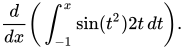
(a) Compute

(b) Find

(c) State the Fundamental Theorem of Calculus.
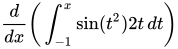
(d) Use the Fundamental Theorem of Calculus to compute without first computing the integral.
| Background Information: |
|---|
| How would you integrate Failed to parse (Conversion error. Server ("https://wikimedia.org/api/rest_") reported: "Cannot get mml. Server problem."): {\displaystyle \int e^{x^{2}}2x~dx?} |
|
You could use -substitution. |
| Let Failed to parse (Conversion error. Server ("https://wikimedia.org/api/rest_") reported: "Cannot get mml. Server problem."): {\displaystyle u=x^{2}.} Then, Failed to parse (Conversion error. Server ("https://wikimedia.org/api/rest_") reported: "Cannot get mml. Server problem."): {\displaystyle du=2xdx.} |
|
So, we get Failed to parse (Conversion error. Server ("https://wikimedia.org/api/rest_") reported: "Cannot get mml. Server problem."): {\displaystyle \int e^{u}~du=e^{u}+C=e^{x^{2}}+C.} |

Solution:
(a)
| Step 1: |
|---|
| We proceed using -substitution. |
| Let Failed to parse (Conversion error. Server ("https://wikimedia.org/api/rest_") reported: "Cannot get mml. Server problem."): {\displaystyle u=t^{2}.} Then, |
| Since this is a definite integral, we need to change the bounds of integration. |
| Plugging our values into the equation we get |
| and Failed to parse (Conversion error. Server ("https://wikimedia.org/api/rest_") reported: "Cannot get mml. Server problem."): {\displaystyle u_{2}=x^{2}.} |


| Step 2: |
|---|
| So, we have |
|
Failed to parse (Conversion error. Server ("https://wikimedia.org/api/rest_") reported: "Cannot get mml. Server problem."): {\displaystyle {\begin{array}{rcl}f(x)&=&\displaystyle {\int _{-1}^{x}\sin(t^{2})2t~dt}\\&&\\&=&\displaystyle {\int _{1}^{x^{2}}\sin(u)~du}\\&&\\&=&\displaystyle {-\cos(u){\bigg |}_{1}^{x^{2}}}\\&&\\&=&\displaystyle {-\cos(x^{2})+\cos(1)}.\\\end{array}}} |
(b)
| Step 1: |
|---|
| From part (a), we have Failed to parse (Conversion error. Server ("https://wikimedia.org/api/rest_") reported: "Cannot get mml. Server problem."): {\displaystyle f(x)=-\cos(x^{2})+\cos(1).} |
| Step 2: |
|---|
| If we take the derivative, we get Failed to parse (Conversion error. Server ("https://wikimedia.org/api/rest_") reported: "Cannot get mml. Server problem."): {\displaystyle f'(x)=\sin(x^{2})2x,} since Failed to parse (Conversion error. Server ("https://wikimedia.org/api/rest_") reported: "Cannot get mml. Server problem."): {\displaystyle \cos(1)} is a constant. |
(c)
| Step 1: |
|---|
| The Fundamental Theorem of Calculus has two parts. |
| The Fundamental Theorem of Calculus, Part 1 |
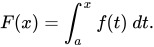
| Let be continuous on and let |
| Then, is a differentiable function on and Failed to parse (MathML with SVG or PNG fallback (recommended for modern browsers and accessibility tools): Invalid response ("Math extension cannot connect to Restbase.") from server "https://wikimedia.org/api/rest_v1/":): {\displaystyle F'(x)=f(x).} |

![{\displaystyle [a,b]}](https://wikimedia.org/api/rest_v1/media/math/render/svg/9c4b788fc5c637e26ee98b45f89a5c08c85f7935)


| Step 2: |
|---|
| The Fundamental Theorem of Calculus, Part 2 |
| Let Failed to parse (MathML with SVG or PNG fallback (recommended for modern browsers and accessibility tools): Invalid response ("Math extension cannot connect to Restbase.") from server "https://wikimedia.org/api/rest_v1/":): {\displaystyle f} be continuous on Failed to parse (MathML with SVG or PNG fallback (recommended for modern browsers and accessibility tools): Invalid response ("Math extension cannot connect to Restbase.") from server "https://wikimedia.org/api/rest_v1/":): {\displaystyle [a,b]} and let Failed to parse (MathML with SVG or PNG fallback (recommended for modern browsers and accessibility tools): Invalid response ("Math extension cannot connect to Restbase.") from server "https://wikimedia.org/api/rest_v1/":): {\displaystyle F} be any antiderivative of Failed to parse (MathML with SVG or PNG fallback (recommended for modern browsers and accessibility tools): Invalid response ("Math extension cannot connect to Restbase.") from server "https://wikimedia.org/api/rest_v1/":): {\displaystyle f.} |
| Then, Failed to parse (MathML with SVG or PNG fallback (recommended for modern browsers and accessibility tools): Invalid response ("Math extension cannot connect to Restbase.") from server "https://wikimedia.org/api/rest_v1/":): {\displaystyle \int_a^b f(x)~dx=F(b)-F(a).} |
| (d) |
|---|
| By the Fundamental Theorem of Calculus, Part 1, |
|
Failed to parse (MathML with SVG or PNG fallback (recommended for modern browsers and accessibility tools): Invalid response ("Math extension cannot connect to Restbase.") from server "https://wikimedia.org/api/rest_v1/":): {\displaystyle \frac{d}{dx}\bigg(\int_{-1}^{x} \sin(t^2)2t~dt\bigg)\,=\,\sin(x^2)2x.} |
| Final Answer: |
|---|
| (a) Failed to parse (MathML with SVG or PNG fallback (recommended for modern browsers and accessibility tools): Invalid response ("Math extension cannot connect to Restbase.") from server "https://wikimedia.org/api/rest_v1/":): {\displaystyle f(x)=-\cos(x^2)+\cos(1)} |
| (b) Failed to parse (MathML with SVG or PNG fallback (recommended for modern browsers and accessibility tools): Invalid response ("Math extension cannot connect to Restbase.") from server "https://wikimedia.org/api/rest_v1/":): {\displaystyle f'(x)=\sin(x^2)2x} |
| (c) See above |
| (d) Failed to parse (MathML with SVG or PNG fallback (recommended for modern browsers and accessibility tools): Invalid response ("Math extension cannot connect to Restbase.") from server "https://wikimedia.org/api/rest_v1/":): {\displaystyle \sin(x^2)2x} |