
On January 27, 2026, HUB 302 at the University of California, Riverside was filled with poster boards, lab notebooks, and a steady hum of scientific curiosity as students from across the Riverside Unified School District (RUSD) gathered for the district’s annual Science and Engineering Fair. For a few hours, the room became a hub of discovery — where local RUSD students shared research, answered probing questions, and stepped into the role of scientists.
For UC Riverside’s College of Natural & Agricultural Sciences (CNAS), hosting the event is more than a one-day partnership. It is part of an ongoing commitment to community engagement, scientific encouragement, and building pathways from local classrooms to future careers.
“This is the future,” said CNAS Dean Peter Atkinson. “These are our future physicians, scientists, and teachers. The pipeline that is coming from multiple schools within RUSD is strong and continuous, and you can’t help but be inspired by the quality of the students and the work they present.”
Science in action — and in conversation
From early morning through midday, volunteer judges — more than 60 faculty members, staff, graduate students, and postdoctoral scholars from across CNAS disciplines — evaluated projects spanning environmental science, biology, chemistry, engineering, and beyond.
For younger students, judges evaluated projects based on poster presentations. For middle and high school students, judging included in-depth conversations about research questions, experimental design, and future directions.
Dr. Stephanie Dingwall, CNAS Divisional Dean of Student Academic Affairs and Associate Professor of Teaching in Biochemistry, helped coordinate the judging effort. She said judges consistently walked away impressed.
“They have been extremely impressed with the students’ caliber — their ability to communicate their ideas clearly, their scientific rigor, and how proactive they are,” Dingwall said. “Some judges even remarked that many of these students would thrive here at UCR.”
The interaction between students and scientists is one of the most meaningful aspects of the event, according to Julie Smith, Instructional Services Specialist for TK–12 Science at RUSD.
“That conversation between students and judges is such a great opportunity for both groups,” Smith said. “Students get to share their ideas and research, and judges get to reconnect with what scientific curiosity looked like when they were younger. It’s inspiring on both sides.”
A campus experience that expands horizons
The science fair itself is only part of the experience. After judging concluded, many students participated in the CNAS Experience — an immersive introduction to life as a university science student.
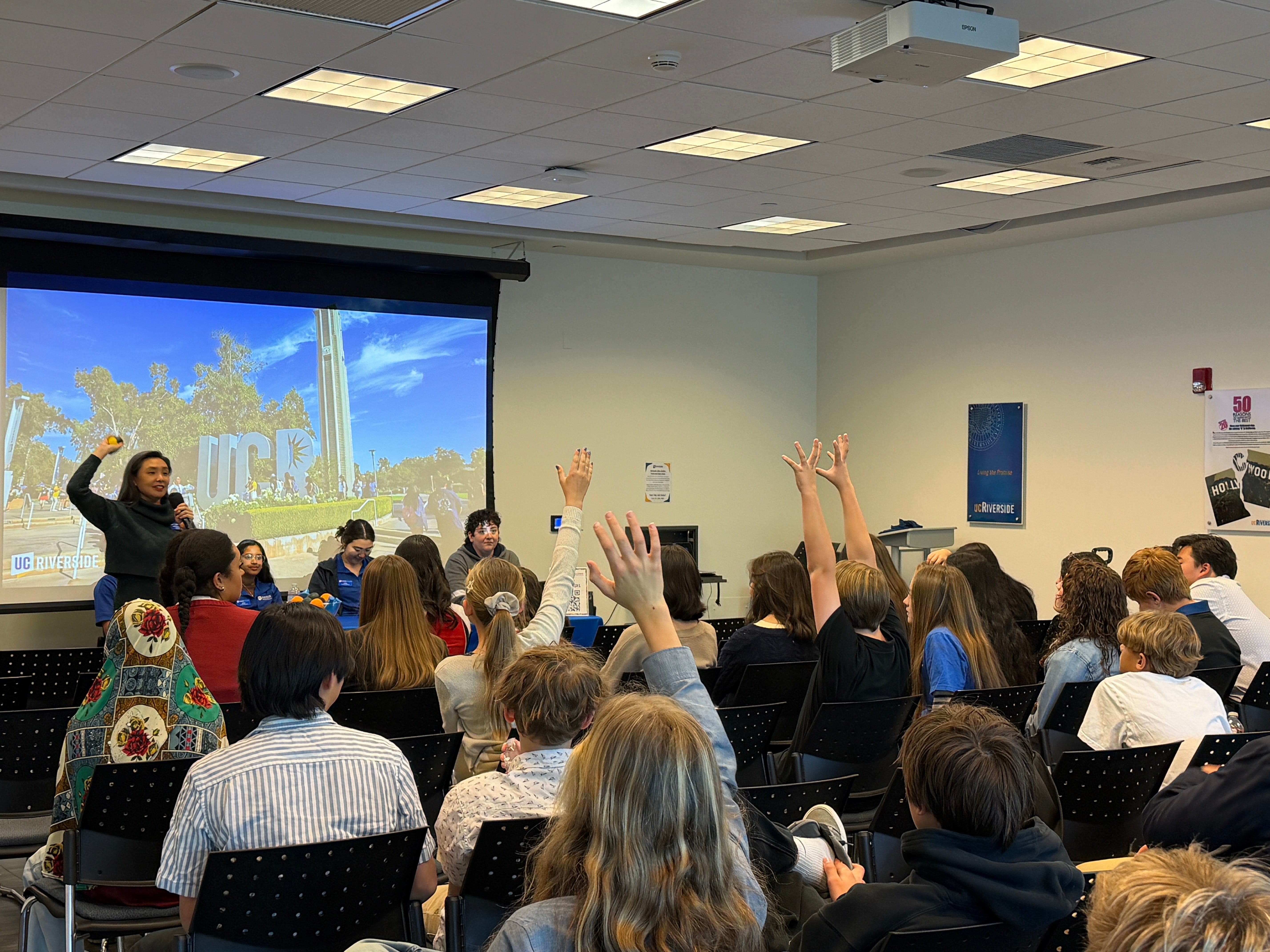
Participants toured campus facilities, visited the Geology Museum, and conducted a hands-on strawberry DNA extraction experiment in a teaching laboratory. They also attended a welcome session and student panel featuring CNAS Science Ambassadors, who shared their academic journeys and answered questions about college life.
For many students and families, the visit marked their first time on a university campus — even for those who have lived in Riverside their entire lives.
“Our goal is to broaden their horizons and show them what is possible,” Smith said. “Some parents told us it was their first time ever being on the UCR campus. That exposure matters — it helps students and families see what their futures could look like.”
Creating that sense of possibility is central to CNAS’s role in the region, Atkinson emphasized.
“We are their University of California,” he said. “We are here for our community. We want students across the Inland Empire to feel a sense of belonging — that this is their university and a place where they can succeed.”
Near-peer inspiration
For CNAS Science Ambassador Amanda Arrieta, the most powerful part of the day is not the judging — it is the conversations.
Arrieta, a biochemistry major and transfer student, spends much of the event talking with students and families, sharing her own academic journey and answering questions about what college is really like.
“When I was their age, I knew college was a concept, but I didn’t really know what it meant,” she said. “So having them here — seeing labs, meeting students, walking around campus — it makes college real.”
She often sees the shift happen in real time.
“You can see it on their faces,” Arrieta said. “They realize, ‘Oh, I could do this.’ That moment — when it feels possible — that’s my favorite part.”
Big ideas from young researchers
The projects themselves reflect the depth of curiosity and ambition among RUSD students.
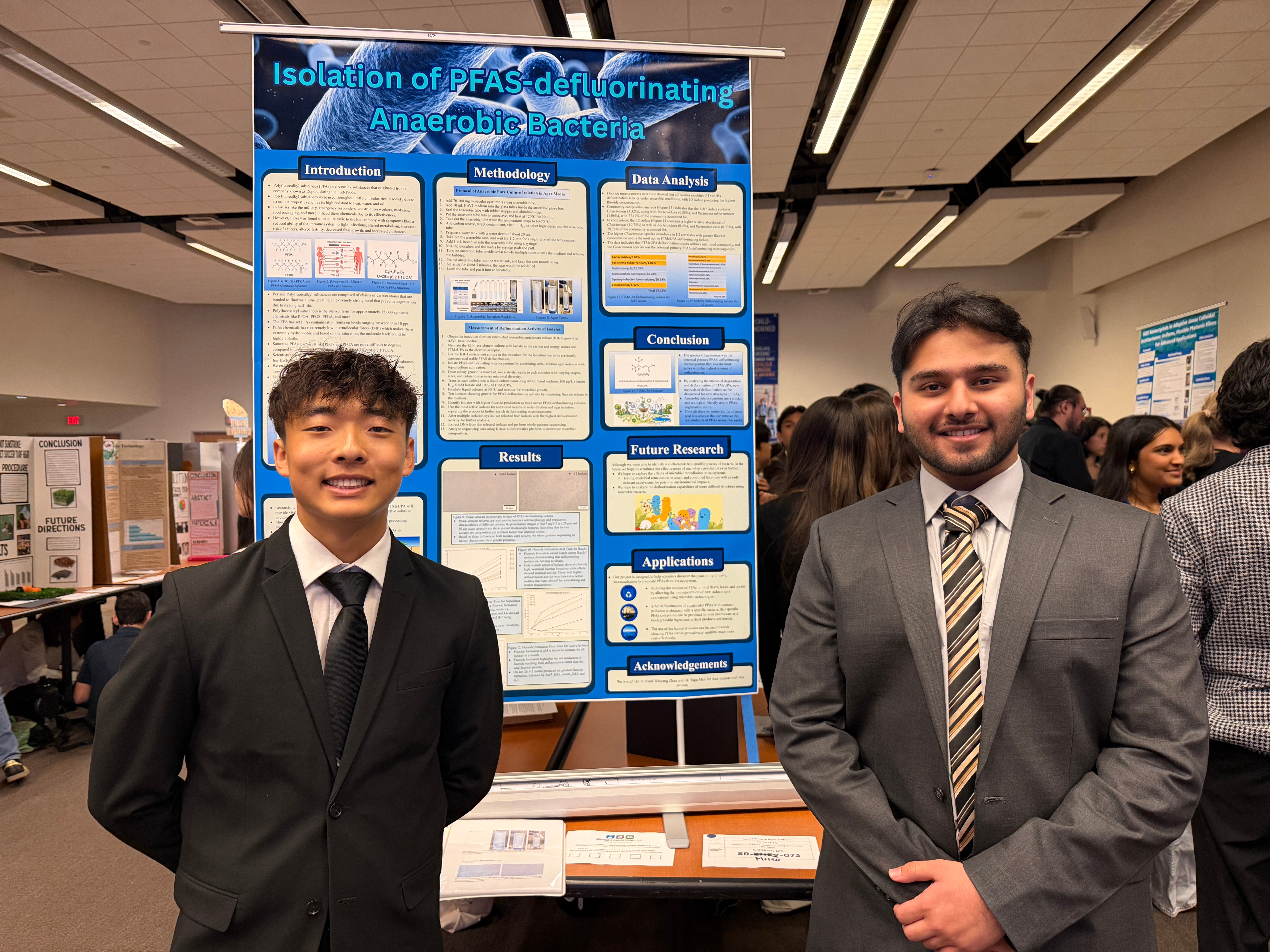
At Martin Luther King High School, juniors and seniors Patrick Moon and Ubaid Awan presented research exploring how bacteria might help break down PFAS — persistent industrial chemicals that contaminate water supplies and pose health risks worldwide. Their work examined whether specific bacterial isolates could help degrade these compounds in an environmentally sustainable way.
Both students were motivated by real-world concerns — environmental impact, human health, and the responsibility to solve problems created by modern industry.
“We want to help address the root causes,” Awan said. “If there’s a way to remove harmful compounds safely and responsibly, that could make a real difference for people.”
Moon added that science offers something uniquely powerful: the ability to create solutions where none existed before.
“Science is about solving problems in creative ways,” he said. “It shows that there is always more to discover — and that we can fix the problems we create.”
Across the room, fellow Martin Luther King High School junior Alyna Burgett presented research on nematodes as natural pest control agents — a potential alternative to chemical pesticides, particularly in regions where agricultural sustainability is critical.
Burgett has spent nearly a year on the project and hopes to continue research in entomology — ideally at UC Riverside, home to one of the world’s leading programs in the field.
“I want to be in a research lab,” she said. “I want to study insects all day. That’s the goal.”
A shared investment in the future
For CNAS leaders and RUSD educators alike, the science fair represents something larger than competition or recognition. It is about exposure, encouragement, and long-term opportunity.
It is also about strengthening a regional ecosystem of learning — one in which universities and school districts work together to cultivate curiosity from an early age.
“We want students to see that discovery is still happening,” Smith said. “That science is not finished — there are still problems to solve, questions to explore, and ideas waiting to be tested.”
For Atkinson, that message carries forward into the future of the region itself.
“This is how we build the next generation,” he said. “By showing students what is possible, by welcoming them onto campus, and by helping them see themselves as scientists.”
As students packed up their projects and prepared for the next stages of competition — including a community showcase and awards ceremony later in the week — one thing was clear: the day had offered more than evaluation. It had offered perspective, inspiration, and a glimpse of what lies ahead.
And for many young scientists walking out of HUB 302, college — and a future in science — felt a little closer than it had before.
###
Let us help you with your search